
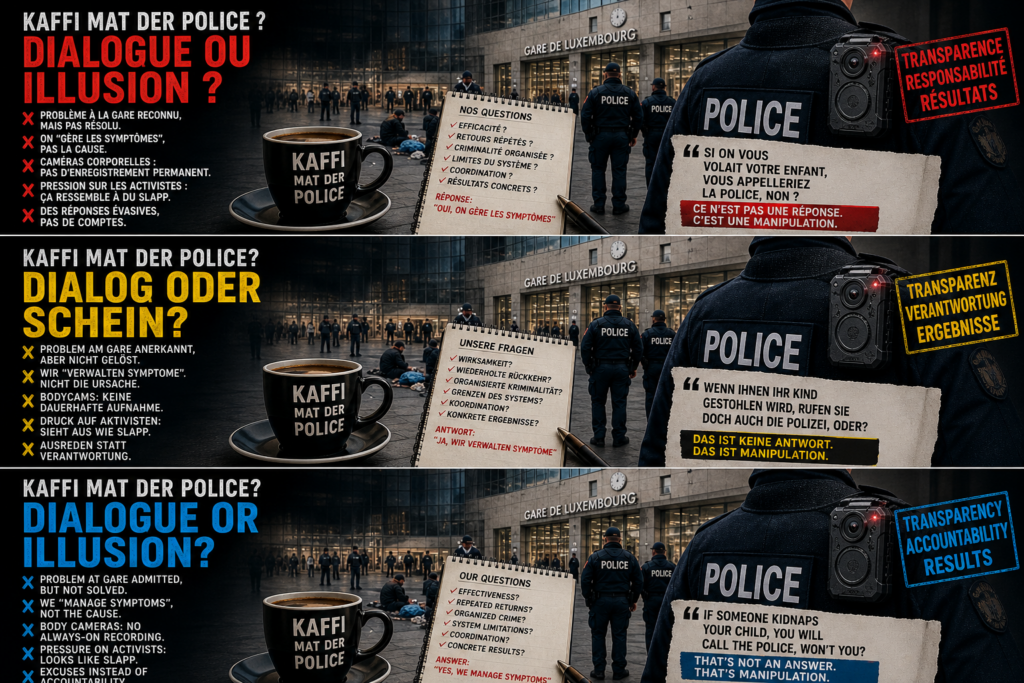
I attended the “Kaffi mat der Police” event organized by Luxembourg Police (officially: Kaffi mat der Police). The format is intended as informal communication with citizens over coffee, without protocol or barriers. In practice, it is an interesting indicator: how willing is the police to engage in real dialogue rather than symbolic interaction?
Gare district: recognition without resolution
The first set of questions concerned the Gare de Luxembourg area, long seen as problematic.
Observable facts:
- open drug scene,
- aggressive behavior,
- organized and unorganized begging,
- recurring incidents.
When asked whether this is a systemic issue rather than isolated cases, the police effectively acknowledged the problem but immediately added limitations: “not everything depends on us.”
This means:
- the problem is recognized,
- responsibility is distributed across institutions.
Effectiveness: presence without outcome
Why does the situation not improve despite constant police presence?
Answer:
- work is ongoing,
- there are constraints,
- the system is more complex than it appears.
However, the key question remains unanswered:
Which parts of the current strategy are not working?
Without this, there is no meaningful evaluation of effectiveness.
“Return cycle”: systemic dysfunction
Repeated presence of the same individuals suggests:
- lack of effective tools,
- non-application of measures,
- or failure to complete enforcement cycles.
Organized activity
Public perception:
the same individuals remain present for months.
This creates the impression of:
- lack of control,
- selective enforcement,
- or insufficient coordination.
Key point: symptom management
Core admission:
the current model manages symptoms more than it solves the problem — “yes”.
👉 The system is controlling consequences, not resolving causes.
Body cameras
- available,
- but not subject to mandatory continuous activation.
Implications:
- limited transparency,
- potential selective recording,
- reduced trust in evidence.
SLAPP and boundaries of authority
Example discussed: a performance involving a simulated charity collection related to a minor in Luxembourg ordered by court to pay legal costs.
Police reaction:
- fraud allegation,
- legal proceedings,
- full dismissal of charges.
This can resemble SLAPP-like pressure mechanisms.
Broader question:
Why does police intervention occur in civil or civic contexts?
Police argument
“If your child is kidnapped, you would call the police”
1. Topic substitution
2. false dilemma
3. emotional pressure
4. avoidance of core issue
Conclusion
✔ problems acknowledged
✔ limitations admitted
✔ symptom management openly stated
✖ no clear strategy
✖ weak accountability mechanisms
✖ limited transparency
✖ rhetorical responses instead of substantive answers
👉 There is dialogue, but it does not yet lead to systemic change.
👉 The system is not focused on solving the problem — it is focused on controlling it.
And without this, such meetings risk remaining not a tool for solutions, but a tool for managing expectations. As long as the model does not change, the Gare district will remain not an exception, but the norm.